इतिहासः
The History of Advaita Sharada
Contemplating on the greatness of the Śāstras and the living Brahma-Vidyā Guruparamparā that reveals their true import and carries this sacred wisdom unbroken across generations.”
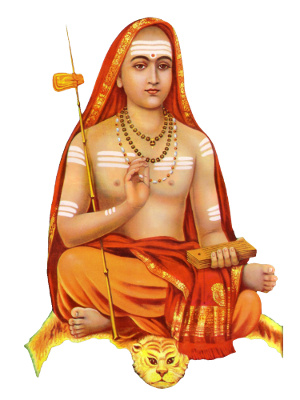
वेदान्ताम्भोगभीरा नयमकरकुला ब्रह्मविद्याब्जषण्डा
पाषण्डोत्तुङ्गवृक्षप्रमथननिपुणा मानवीचीतरङ्गा ।
यस्यास्योत्था सरस्वत्यखिलभवभयध्वंसिनी शङ्करस्य
गङ्गा शम्भोः कपर्दादिव निखिलगुरोर्नौमि तत्पादपद्मम् ॥
This path of dharmic welfare has shone forth as a light of peace and wisdom that has emanated from Bharatavarsha since time immemorial. This dharmic light has been kept burning by divine incarnations who appeared according to the needs of each age.
Among the divine incarnations, Jagadguru Sri Adi Shankaracharya, born at Kalady in Kerala more than a millennium ago, stands unique. Appearing at a time when the tenets of Sanatana Dharma had come to be grossly misinterpreted and misunderstood, Sri Shankaracharya’s mission was to rejuvenate Sanatana Dharma by bringing about a transformation in the minds of its followers. To this end, He wrote and taught comprehensive commentaries, the Bhashyas on the three principal scriptural foundations of Vedanta—the Prasthanatraya.
In this present age, Dakshinamnaya Sringeri Sri Sharada Peethadhipati Jagadguru Shankaracharya Sri Sri Sri Bharati Tirtha Mahaswamiji dedicated the Advaita Sharada project on the auspicious occasion of Shankara Jayanti in 2014, to serve the needs of scholars and students of Vedanta across the world.
Carrying this sacred initiative forward, Jagadguru Shankaracharya Sri Sri Sri Vidhushekhara Bharati Mahaswamiji dedicated the revamped Advaita Sharada in 2026, incorporating state-of-the-art technologies to further enhance the study, preservation and dissemination of the Shastras.
Twelve centuries ago
The Vyakhyana Simhasana - The Throne of Vedantic Exposition — Dakshinamnaya Sri Sharada Peetham established at Sringeri
A remarkable prodigy who mastered the Vedas at an early age, Jagadguru Sri Shankaracharya was initiated into Sannyasa ashrama at the tender age of 8. He then mastered the Shastras and wrote the Prasthaana Traya Bhashyas — comprehensive commentaries on the three principal texts of Vedanta the Upanishads, the Bhagavad Gita and the Brahma Sutras. He also penned many independent Vedantic treatises like the Vivekachoodamani and numerous devotional hymns.
Traveling throughout India, Sri Adi Shankaracharya taught the Upanishadic philosophy of Advaita (non-dualism), reformed religious practices, and revived Sanatana Dharma. To preserve this knowledge for future generations, He established four major spiritual centers (Aamnaaya Peethams) in the four directions of India – Sringeri, Dwaraka, Puri and Badrinath. He concluded His extraordinary life at the age of thirty-two at Kedarnath.
Jagadguru Sri Adi Shankara Bhagavatpada consecrated Goddess Sharadamba and established the first of the four Amnaya Peethams at Sringeri in present-day Karnataka more than twelve centuries ago to foster the sacred tradition of Sanatana Dharma. Bhagavatpada appointed His prime disciple, Sri Sureshwaracharya as the first Acharya of this Dakshinamnaya Sri Sharada Peetham. Since then, the Peetham has been blessed with an unbroken Guru Parampara, a garland of spiritual masters and Jivanmuktas. The Acharyas have led a life of such austere penance that it has led disciples to adore in them the radiance of Sri Adi Shankaracharya Himself.
Besides being a centre of spiritual power, Sringeri came to be known as a great place of traditional learning owing to the presence of Sri Sharadamba and the erudition of the Acharyas of the Peetham. The Acharyas were instrumental in bringing forth commentaries on the Vedas. The Acharyas authored original texts in Vedanta such as Tattvashuddhi, Vaiyasika Nyaya Mala, Panchadashi, Jeevanmukti Viveka, and also elaborated on the works of Bhagavatpada by penning texts such as Bhashya Vartikas, Manasollasa, Vidyasri, Vivekachudamani-vyakhya etc. They also penned a number of hymns underlining their ardent devotion to the non-dual Supreme worshipped in multifarious forms.
The sacred Sringeri Guru Parampara has been an exemplar in preserving the knowledge tradition revived by Jagadguru Sri Adi Shankaracharya by ensuring the study, teaching assimilation of the knowledge tradition culminating in direct experience of the divine non-dual state of Absolute Reality, as expounded in the Upanishads.
The knowledge tradition revived by Jagadguru Sri Adi Shankaracharya has thus been protected and preserved by passing it on from one generation to the next by the erudite Acharyas, the illustrious Jagadgurus of Dakshinamnaya Sri Sharada Peetham at Sringeri. The Peetham thus came to be known as the Vyakhyana Simhasana –The Throne of Vedantic Exposition. The presiding Acharya is hailed as the adorner of this throne. Many regard Goddess Sharada Herself to be moving in the form of the presiding Acharya of the Peetham
Our tradition places the Guru who imparts Brahma-vidya as the highest object of our devotion. All the Jagadgurus of the Peetham have carried aloft the torch of Dharma and guided Astikas, from that day to this.
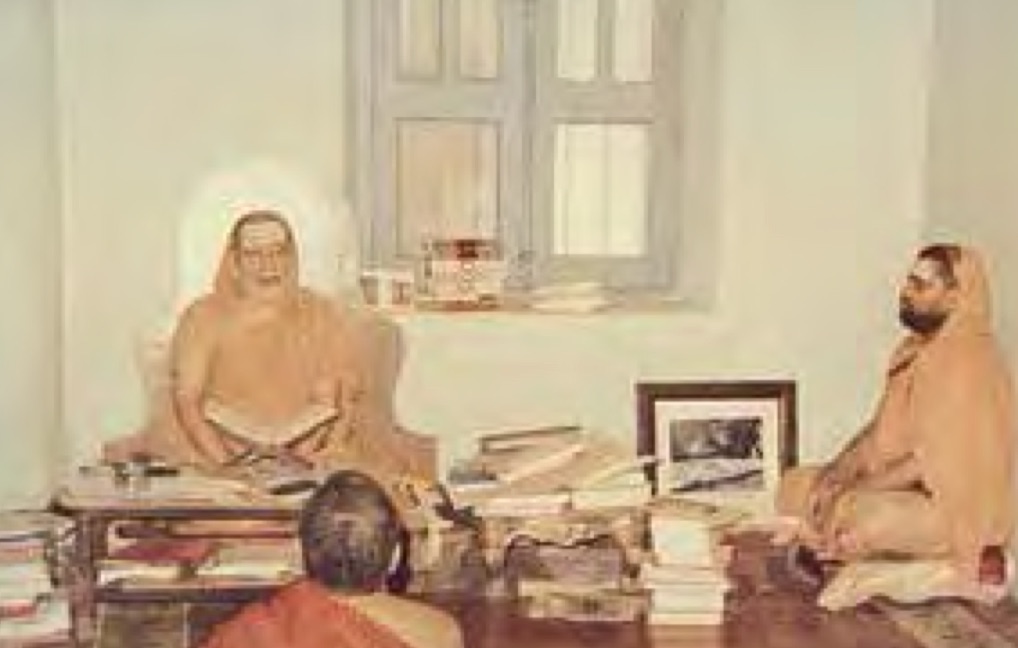
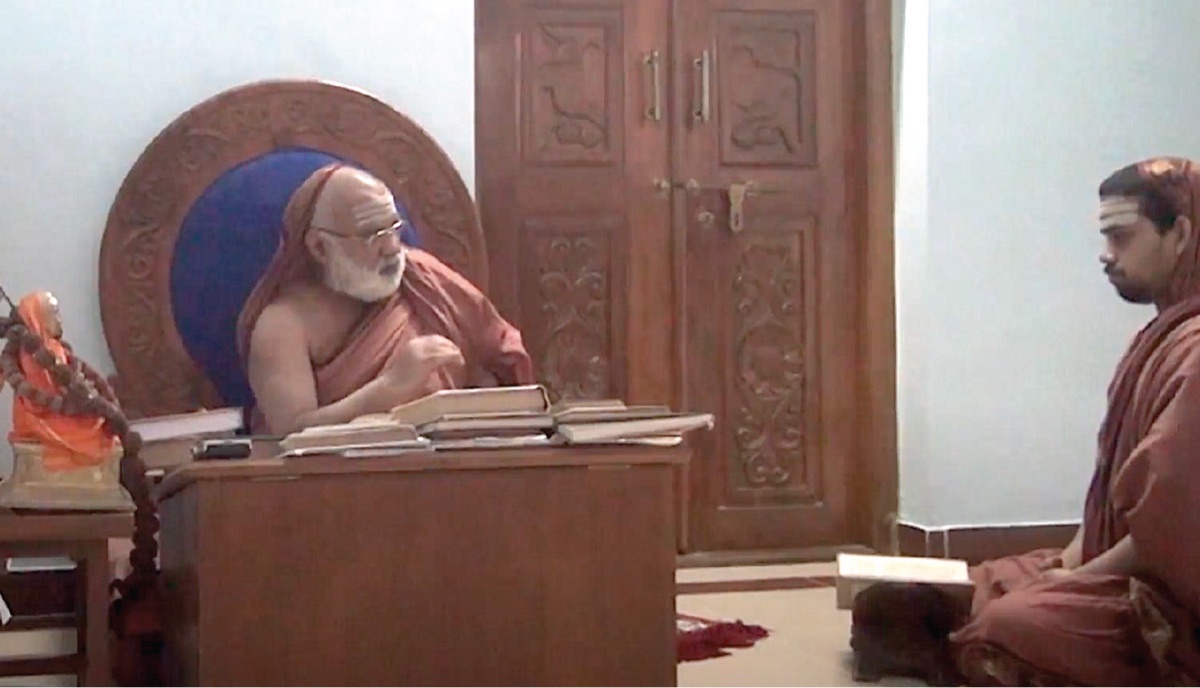
The unbroken transfer of Brahma-vidya
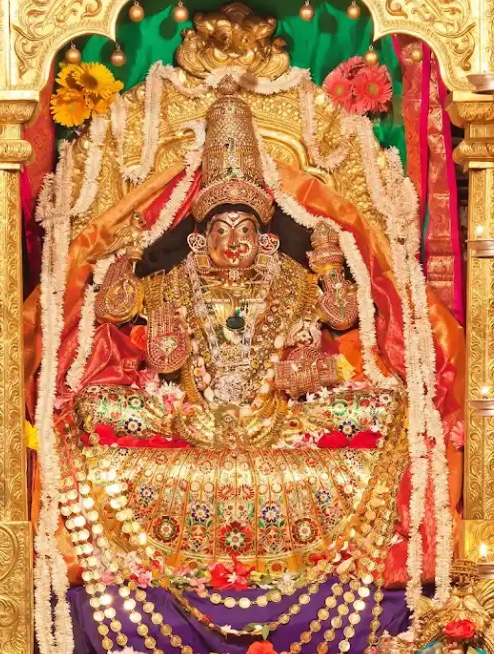
There is much similarity between Bhagavati Sharadamba and Bhagavan Dakshinamurti. Sri Sharadamba sports in Her four hands the Jnana Mudra, a book, a Japa Mala and the Amrita-kalasha (pot of nectar). Sri Dakshinamurti also sports the same in His hands. This verse depicts this aspect of Sri Dakshinamurti:
स्फटिकललितवर्णं मौक्तिकीम् अक्षमालाम् अमृतकलश-विद्या-ज्ञानमुद्राः कराब्जैः ।
दधतमुरगकक्ष्यं चन्द्रचूडं त्रिनेत्रं विधृतविविधभूषं दक्षिणामूर्तिमीडे ॥
Similarly, this verse describes Sri Sharadamba in a similar fashion:
माला-सुधाकुम्भ-विबोधमुद्रा-विद्या-विराजत्करवारिजाताम् ।
अपारकारुण्यसुधाम्बुराशिं श्रीशारदाम्बां प्रणतोऽस्मि नित्यम् ॥
1909
A sacred resolve translated into reality
The ancient saying “ऋषीणां पुनराद्यानां वाचमर्थोऽनुधावति” — “In the case of the great Ṛṣis of old, meaning itself follows their words” — seems to find a striking illustration in the life of Jagadguru Śrī Sacchidānanda Śivābhinava Nṛsiṁha Bhāratī Mahāsvāmiji.
Endowed with extraordinary Tapas, spiritual insight and unwavering dedication to Dharma, the Jagadguru did not merely envision great undertakings; his Saṅkalpas took concrete form. The rediscovery of Kālaḍy and the establishment of temples there, the collection and publication of the works of Śrī Ādi Śaṅkara Bhagavatpāda as the Śāṅkara Granthāvali, and the establishment of institutions for the preservation and propagation of Vedic and Śāstric learning stand as enduring examples of how his sacred resolve translated into reality.
In the divine life of the Jagadguru, the ancient description of the Ṛṣis seemed to come alive — the words of His Holiness did not merely follow events; events themselves seemed to follow His sacred words as commands.
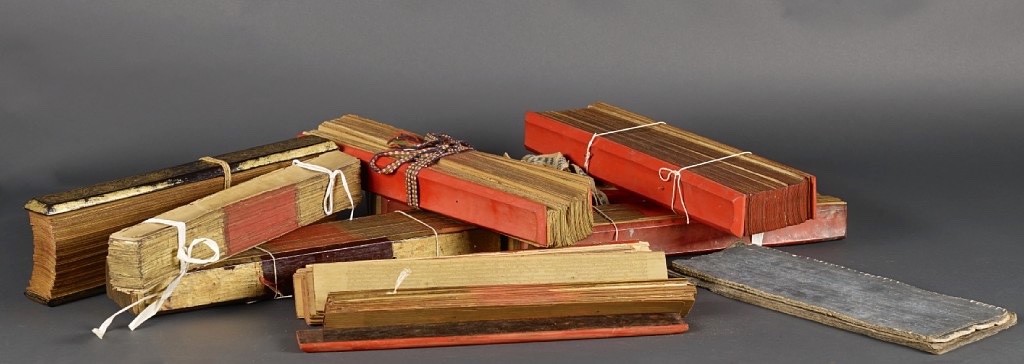
At the dawn of the twentieth century, the works of Sri Bhagavatpada remained preserved in palm-leaf manuscripts—some housed in manuscript libraries and others scattered across different places. At the same time, several works of doubtful authenticity had come to be attributed to Bhagavatpada, adding to the need for a careful collection and critical examination of his works.
Sri T. K. Balasubrahmanya Iyer, who was entrusted by the Jagadguru with the onerous task of bringing out this monumental publication, records:
“It was at Papanasam in the Tirunevelly District that His Holiness first conceived the idea of a uniform and accurate edition of all the genuine works of the great world-teacher whose writings are the wonders of the world. This publication was considered by His Holiness to be a fitting supplement to the consecration of the temple of Sri Sankara at Kaladi. Accordingly His Holiness commanded me to print and publish a uniform and as far as possible an accurate edition of all the available works of this mighty intellect and make it a memorial of the consecration at Kaladi. In obedience to his esteemed commands and with the help of his divine blessings I commenced this publication in August 1909.”
Of course it was a Bhagiratha Prayatnam so the journey was not easy. Almost everything went wrong. The electricity failed. The engine would not move. The printing machine broke, and no one nearby could mend it. Paper had to be ordered from England, where strikes held up the ships. Compositors fell sick. Proof-readers ran away. Pandits took offence and stayed home. People he loved fell ill; some died. He spent forty thousand rupees of his own money before a single volume could appear.
What kept him going, he wrote
“But on all these occasions invariably I had a cheering word or two from the lips of His Holiness and his beneficent smile would goad me on to my task with renewed vigour and fresh zeal. But for the living presence of His Holiness I would have become bewildered in the maze of troubles and hindrances and would have sunk long ago into oblivion. His Holiness would never leave me to that fate but would drag me on ever onward into the path of brightness and sunshine and hold aloft before me the banner emblazoned with the word “Excelsior” in letters of gold.”
Thus we understand that,
Every doubtful reading and every question concerning the authenticity of a work was referred to the Jagadguru. Revered as Abhinava Shankara, His Holiness resolved such doubts with authority. Indeed, many of the shorter works and hymns were recited by His Holiness from memory and written down as He spoke.
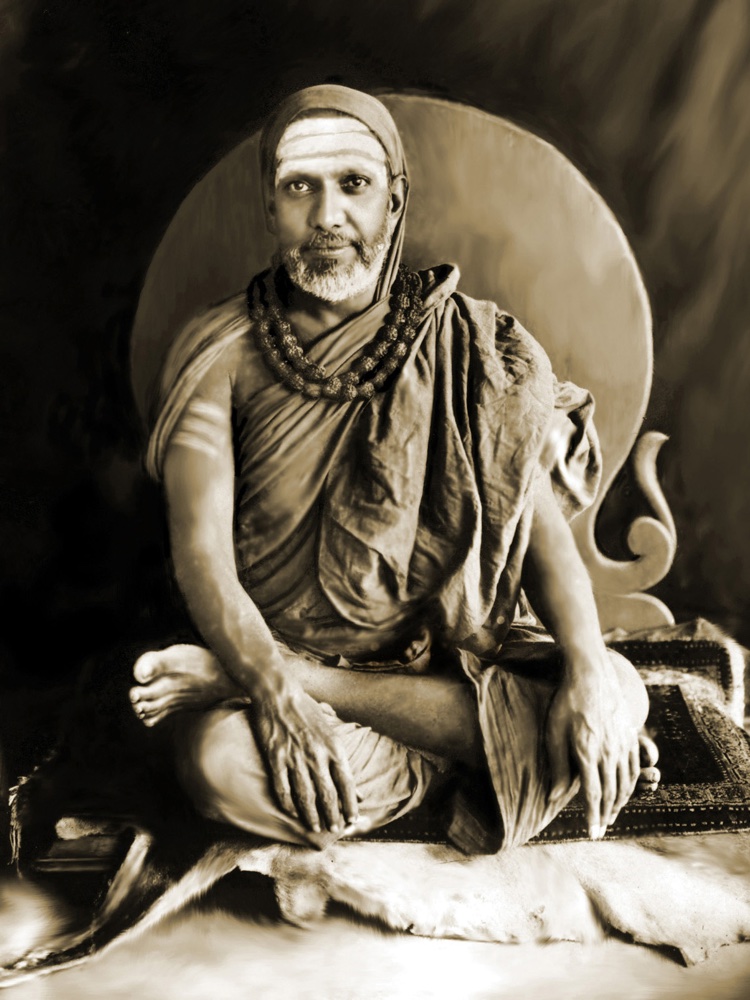
अष्टमे हायने यश्च तुर्यमाश्रममग्रहीत्। प्रस्थानत्रयभाष्यादेर्लेखको द्योतकश्च यः ॥
शङ्करः सच्चिदानन्दशिवाभिनवपूर्वकः ॥ नृसिंहभारती चेति नामद्वयविराजितम् ।
जगद्गुरुमहं वन्दे लोकानुग्रहदीक्षितम् ॥
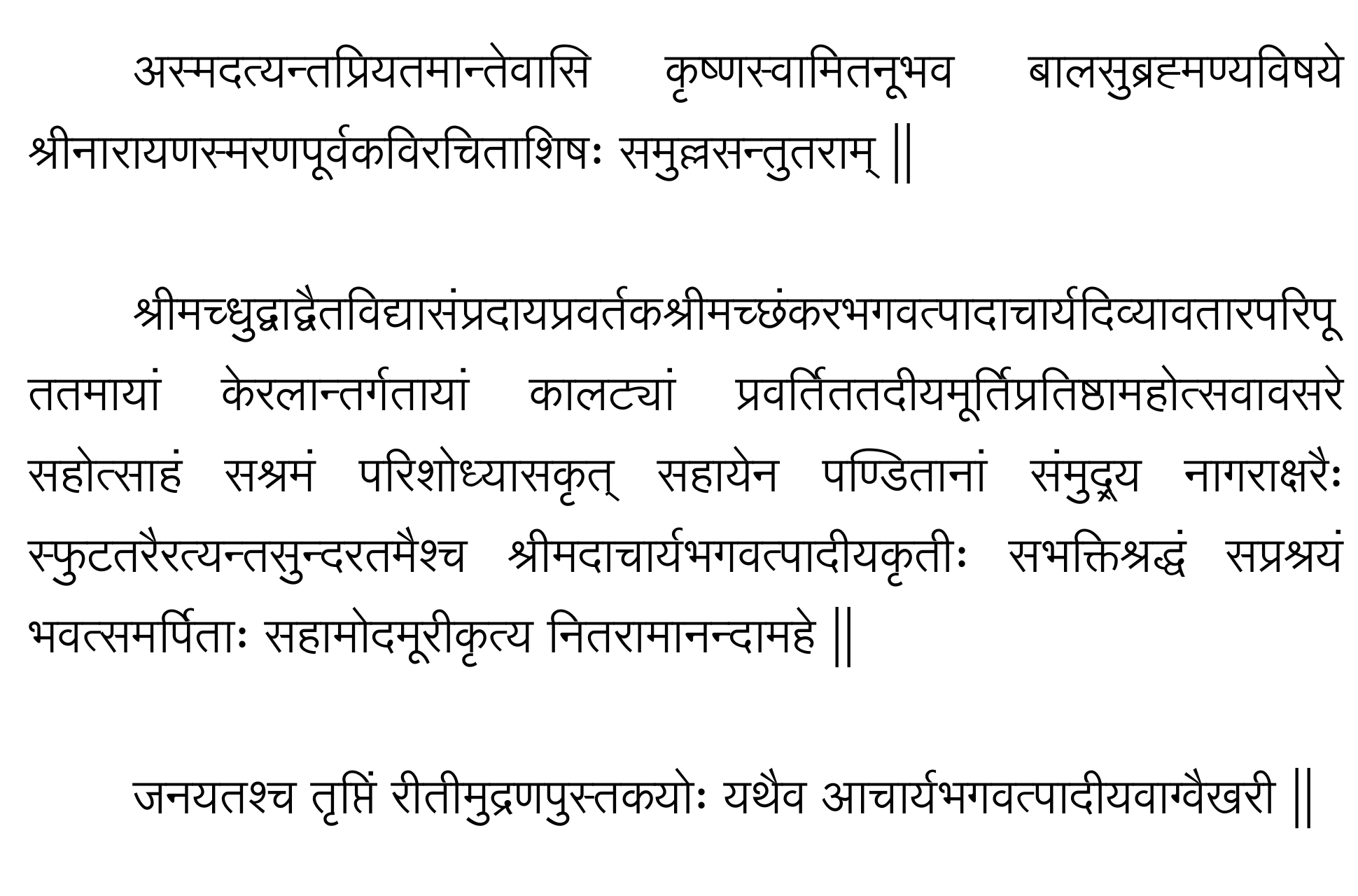
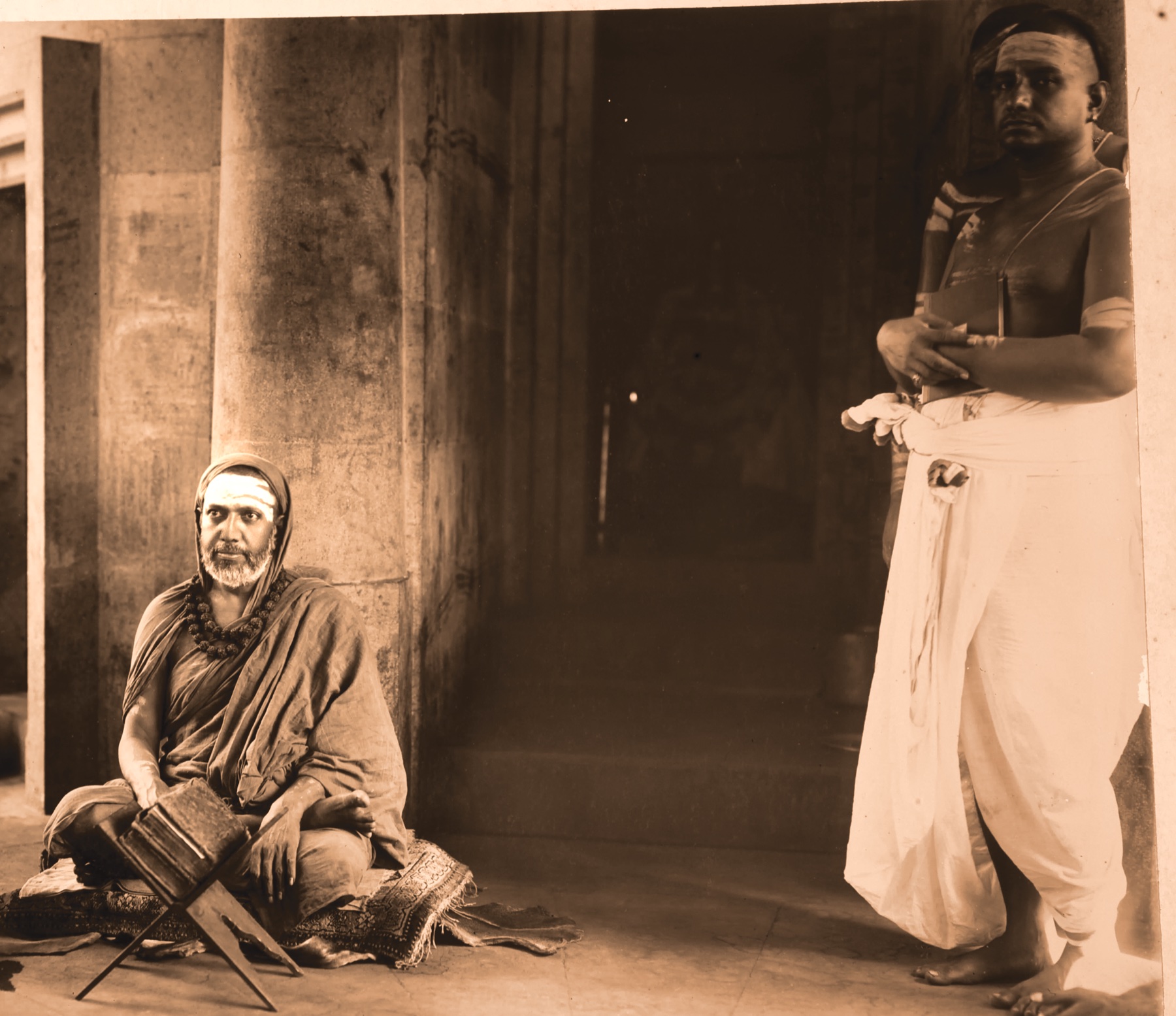
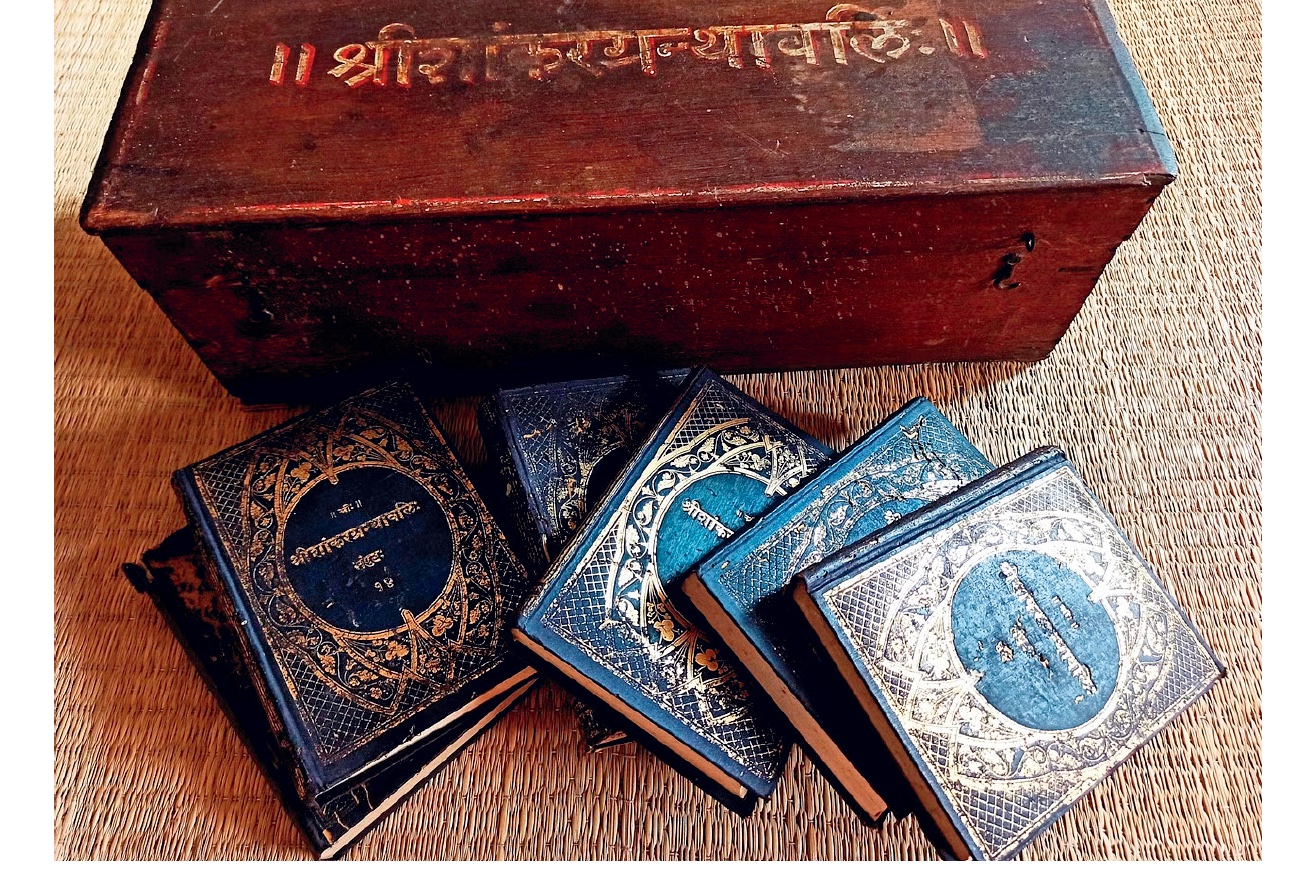
The complete works of Shankaracharya, 1910 — from manuscript to book. The box is lettered ॥ श्रीशांकरग्रन्थावलिः ॥
Balasubrahmanyam finished all twenty volumes. He carried the first complete set to Sringeri and laid it before the Mahasamadhi. One night at Sringeri, he wrote, His Holiness appeared to him in person, accepted the complete set, took each volume in his hand, went through a portion of the text, and told him that the greatest desire of his heart was accomplished.
The next day he presented the set, bound in silk in a rosewood box, to the present Guru, Sri Chandrasekhara Bharati Mahaswamiji, at the Navaratri Durbar. His Holiness gave him a Rudraksha mala set with precious stones and, by a Srimukha, the title गुरुभक्तशिखामणिः — in obedience, he said, to the commands of the late Jagadguru himself.
A new century
Shastra and the living tradition that reveals its true meaning continue their unbroken journey across generations
The preservation of our sacred texts cannot end with safeguarding their written form. Palm-leaf manuscripts may be carefully preserved, their contents may be transferred to printed books, and today they need to be digitised and made accessible through modern technology. All these efforts are indispensable—but the physical preservation of a Grantha alone does not ensure the preservation of the knowledge enshrined in it.
The Śāstras constitute a living tradition of knowledge. Their profound import, culminating in the highest knowledge, has been transmitted through the Guru-Śiṣya Paramparā, wherein a competent Guru unfolds the Śāstra to a qualified Śiṣya. It is this living transmission that preserves not merely the words of the Śāstras, but their true meaning, their traditional interpretation and the methodology by which they are understood.
For more than a millennium, the Jagadgurus of the Dakṣiṇāmnāya Śrī Śāradā Pīṭham at Sringeri have stood as guardians of both these dimensions of the Śāstric tradition.
Through personal teaching, the training of scholars, Veda and Śāstra Pāṭhaśālās, Vidvat Sabhās and encouragement of traditional scholarship, they have ensured that the Guru-Śiṣya Paramparā remains a living and unbroken stream of knowledge.
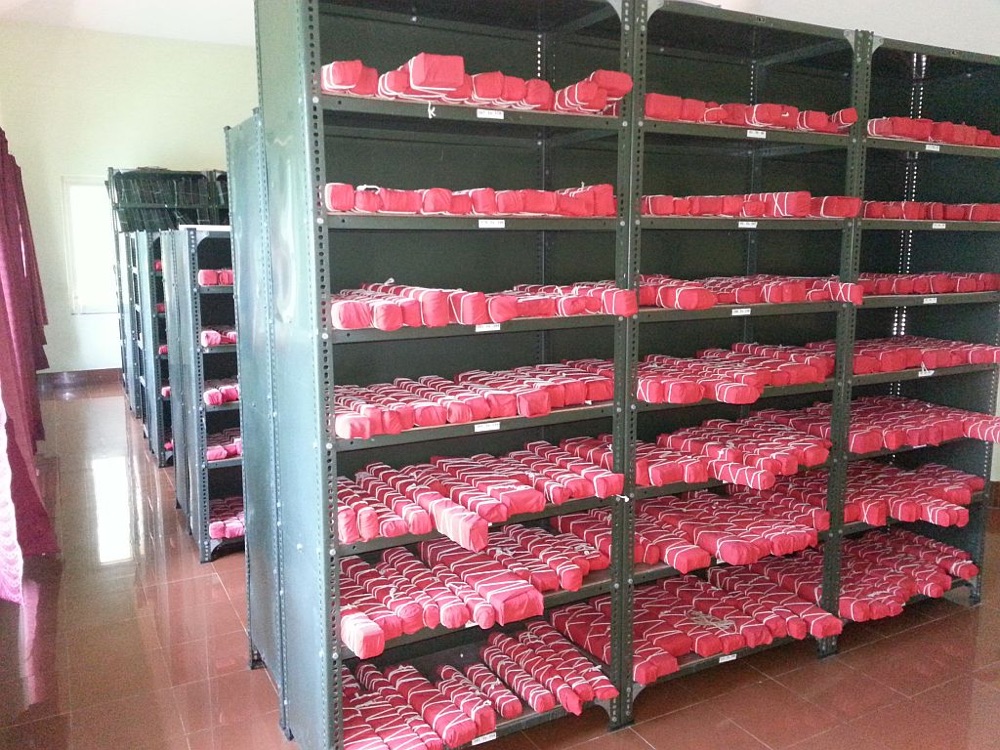
At the same time, the Jagadgurus have taken extraordinary measures to preserve the Granthas themselves. Manuscripts were sought out, collected and safeguarded; authoritative works were carefully examined and brought into print; rare and unpublished texts were published and made available to scholars and seekers.
The medium may change with the age, but under the guardianship of the Sringeri Guruparamparā, both the Śāstra and the living tradition that reveals its true meaning continue their unbroken journey across generations.
The Sringeri Sharada peetham continues to uphold the timeless principles of Sanatana Dharma under the divine leadership of the 36th Acharya, Jagadguru Shankaracharya Sri Sri Bharati Tirtha Mahaswamiji. A treasure trove of spiritual wisdom and peace, the Mahaswamiji is a scholar par excellence in the Vedas and Shastras, including Vedanta, Nyaya, Mimamsa, and Vyakarana. He personally teaches the Shastras to eligible students and presides over the prestigious Mahaganapati Vakyartha Vidwat Sabha. He founded the Shastra Poshaka Sabha for the preservation of traditional education and established the Sri Shankara Advaita Research Centre, which publishes rare and hitherto unpublished texts under the “Sri Bharati Tirtha Veda Shastra Granthamala” series.
The Mahaswamiji also brought forth in 2014 the first ever online hyperlinked version of the Prasthana-traya bhashya under the name “Advaita Sharada”. Under the direct guidance of the Jagadguru and His abundant blessings. The Sri Shankara Advaita Research Centre of the Sringeri Math took up the work, with Sriranga Digital Software Technologies of Mysore beside it.
In 2015, the Mahaswamiji anointed His successor, Jagadguru Shankaracharya Sri Vidhushekhara Bharati Mahaswamiji, a profound scholar who has conducted Vijaya Yatras from Kanyakumari to Kashmir and continues to guide devotees while preserving the Advaita tradition and guiding Advaita Sharada project.
Journey of Advaita Sharada project.
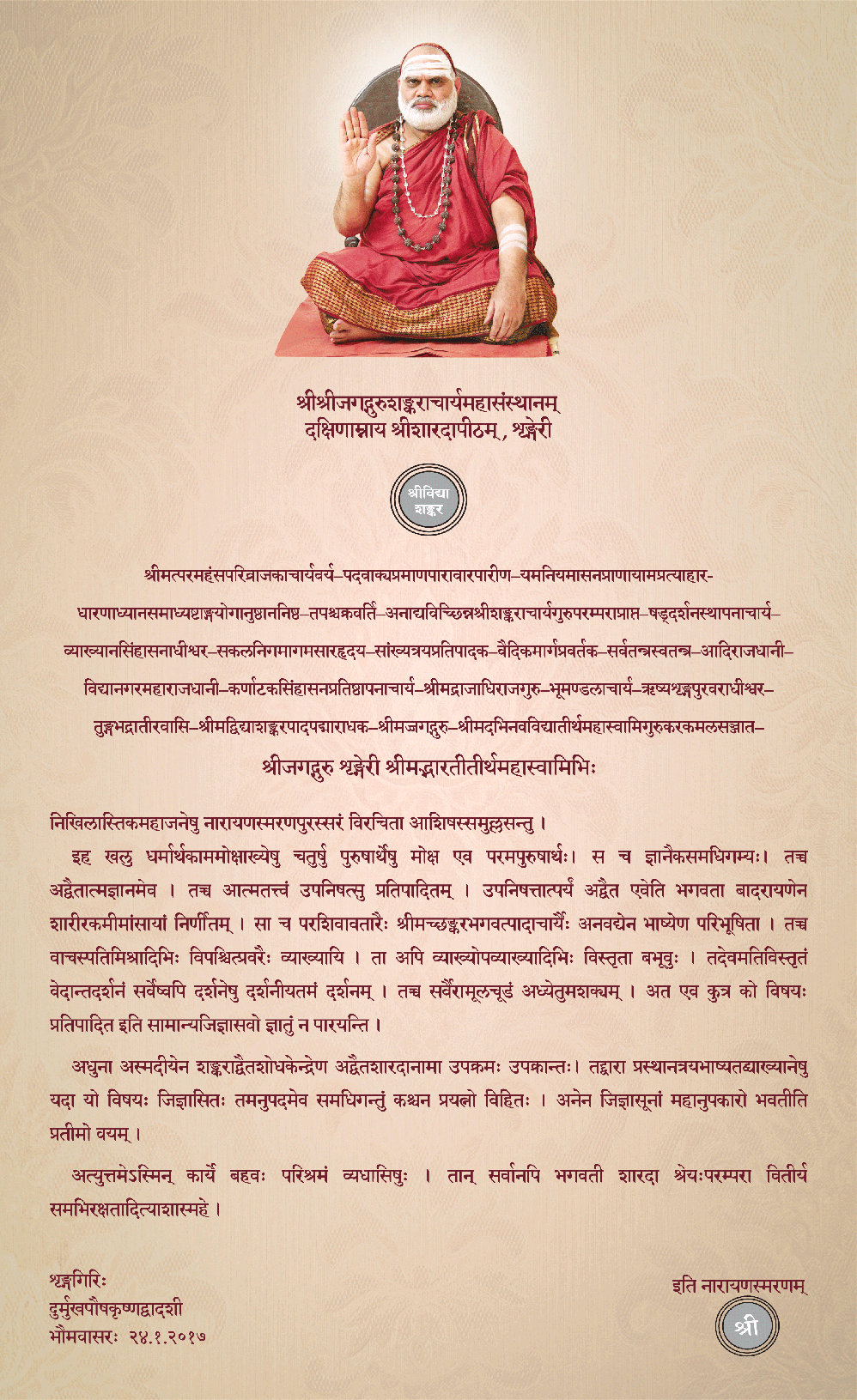
On Shankara Jayanti in 2014, the site went live with the three great commentaries — on the Upanishads, the Gita and the Brahmasutras — as text that could be searched and linked. On 2 February 2017, Sri Sri Bharati Tirtha Mahasannidhanam released the second edition: thirty works, seven and a half lakh words, four thousand links. On 14 September 2019, at the closing of the Mahaganapati Vakyartha Vidwat Sabha, Sri Sri Vidhushekhara Bharati Sannidhanam released the third, in which the commentaries of later Acharyas took their place beside the master's words.
Today
What you can do here
The site you are now exploring is the revamped version of Advaita Sharada. It brings together more than fifty Granthas, comprising over seventy thousand passages—the works of Sri Bhagavatpada, authoritative commentaries on them, and other important works of the tradition. Here is an overview of the features that make this vast repository easier to explore, study and navigate.
Read in your own script
Devanagari, Kannada, Telugu, Tamil, Malayalam or IAST — one choice at the top, and every page follows.
Open a commentary beside the text
Reading the Brahmasutra Bhashya? Press one button and the Bhamati, or the Ratnaprabha, or another commentary opens next to it. The words being explained light up in the bhashya.
- New
Go straight to a verse
Every sutra, mantra and shloka is a small numbered button in the side panel, under its own chapter. Know the number? You are there in one tap.
Search the whole library
Type a few words in Devanagari, in IAST, or in plain Roman letters — "brahma devanam" works just as well. The results take you to the exact passage, with the words marked.
- New
Follow a citation
When a commentary quotes the Veda, the Gita or the Sutras, and the passage it quotes is on this site, the reference is a link. One tap, and you are reading that passage in its own book.
Read the root text alone
Sometimes you want only the sutras, or only the mantras. One button hides the commentary; one button brings it back.
- New
Keep your own bookmarks
Select a passage and bookmark it. Your bookmarks wait for you under चिह्नितानि, grouped by grantha and in reading order, with a note if you want one. You can also copy a passage with its full reference, or copy a link that opens with the passage marked.
- New
Ask about a reading
Think a word is wrong? Select it, press शङ्का, write a line if you like, and it goes straight to the editors' desk.
- New
Read the way you like
Make the letters bigger or smaller. Choose a light, sepia or dark page — or read on palm leaves. Everything works on a phone, with the same care as on a large screen.
Always
The same care, in every age
The medium may change with age, but under the guardianship of the Sringeri Guruparamparā, both the Śāstra and the living tradition that reveals its true meaning continue their unbroken journey across generations.
The following is an excerpt from the sacred Anugraha Bhashanam of Jagadguru Shankaracharya Sri Sri Vidhushekhara Bharati Mahaswamiji:
Sampradaya (tradition) is very important here and we glean our learnings through the Guru Parampara that is part of the sampradaya. It is said of our Guru Parampara:
सदाशिव-समारम्भाम् शङ्कराचार्य-मध्यमाम्
अस्मदाचार्य-पर्यन्ताम् वन्दे गुरु-परम्पराम् ॥
sadāśiva-samārambhām śaṅkarācārya-madhyamām
asmadācārya-paryantām vande guru-paramparām
This Parampara originates from Bhagavan Sadashiva. Here the name and form of Bhagavan does not matter because it is the same Chaitanya manifested in the form of Sadashiva, Narayana etc. Therefore we all study this Advaita-siddhanta under the tutelage of a Guru-Shishya Parampara which originates from Bhagavan Himself. This is not a philosophy which some individual has formulated on his own, employing his own intellect, and then instructed others. The originator of this knowledge is Bhagavan Himself. Bhagavan does not have any Guru. This is thus a knowledge which has been handed down since time immemorial through a parampara. This knowledge is referred to as Brahma Vidya or Advaita Vidya or Vedanta Vidya. To study this Vedanta Vidya, a Guru-Shishya Parampara is most essential because it is a highly subtle and abstruse principle. It cannot be grasped by the limitations of our own intellect and certainly not something we can understand from a book, etc. The Kathopanishad says:
उत्तिष्ठत जाग्रत प्राप्य वरान्निबोधत ।
क्षुरस्य धारा निशिता दुरत्यया दुर्गं पथस्तत्कवयो वदन्ति ॥
uttiṣṭhata jāgrata prāpya varānnibodhata
kṣurasya dhārā niśitā duratyayā durgaṃ pathastatkavayo vadanti
उत्तिष्ठत जाग्रत - uttiṣṭhata jāgrata - It means ‘wake up from the sleep that is avidya (ignorance)’.
वरान् प्राप्य - varān prāpya - ‘seek refuge in an eminent Guru’.
निबोधत - nibodhata - ‘learn and understand this Advaita Tattva’. Make the effort to understand it.
Why should we learn under an eminent Guru? Because ‘क्षुरस्य धारा निशिता दुरत्यया दुर्गं पथस्तत्कवयो वदन्ति’ - kṣurasya dhārā niśitā duratyayā durgaṃ pathastatkavayo vadanti - this is a very subtle principle which must be learnt only from a Guru and the right Guru at that.
‘क्षुरस्य धारा’ - kṣurasya dhārā - like the sharpness of the tip of a sword, this is also a very subtle and abstruse path. Only if we are very careful and attentive is it possible to walk this path. Only then is it possible to truly understand the essence of Advaita. If we do not properly understand the meaning, we run the risk of misunderstanding and misinterpreting it. This also leads to anartha (misdeed). We must therefore appreciate that there is a set sampradaya in the Shastras to study this.
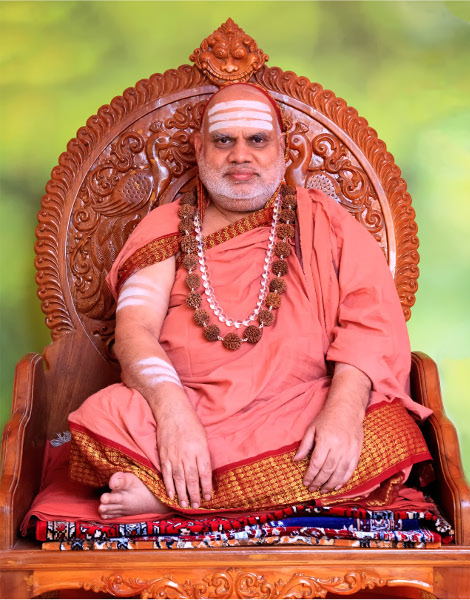
श्री श्री श्री भारतीतीर्थ महास्वामिनः
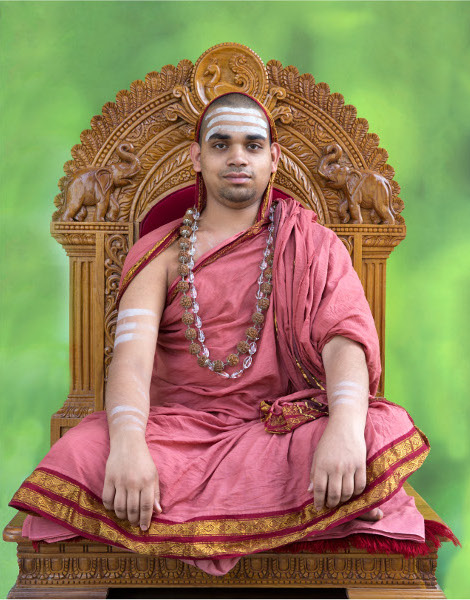
श्री श्री श्री विधुशेखरभारती महास्वामिनः